Dry forest and plant life
Jaragua’s Dry Forest and Cacti: Discovering Plant Life around Cabo Rojo
Look beyond the beaches to Jaragua's cacti, trees and dry-forest habitats. Discover what to notice, how vegetation changes and how to enjoy a plant-focused nature walk.
Look beyond the beach and notice the living landscape
The journey around Cabo Rojo and Pedernales, in the Dominican Republic, introduces a landscape that can surprise visitors expecting continuous lush greenery. Cacti, thorny shrubs, pale rock and trees with open crowns can sit close to the turquoise coast. Slow down and these are more than a backdrop to the beach: they reveal a different way for plants to live with seasonal water shortages, strong sunshine and demanding ground conditions.
This guide introduces the plant life and landscape of Jaragua rather than offering a checklist of guaranteed species. The Jaragua National Park guide explains the wider protected area, which includes several environments on land and at sea. A dry-forest visit shows one part of that variety. You do not need botanical training to enjoy it; curiosity about shapes, shade, bark and the relationship between plants and animals is a useful starting point.
A tropical dry forest is not an empty desert
A tropical forest does not have to look like a rainforest. In a dry forest, the availability of water shapes the vegetation and its seasonal appearance. Trees, shrubs, climbers and cacti can form a layered, living community even when the scene looks sparse from a passing vehicle. Jaragua contains dry-forest and thorn-scrub environments, but the park should not be imagined as one uniform stretch of bare ground or one continuous wall of tall trees.
Look at the spaces between the tallest plants as well as the skyline. Smaller shrubs, fallen leaves, shaded patches and pockets among rocks are part of the habitat. An apparently open landscape can contain subtle differences over a short distance. Ask a guide what helps explain those differences in the area you are actually visiting. A coastal view cannot tell you everything about the soil, exposure or vegetation further inland.
Read seasonal changes without assuming the forest is dying
Some dry-forest trees shed leaves as a way of reducing water loss during dry periods. A leafless crown therefore does not automatically mean a dead tree. Other plants retain foliage, while succulent stems can store water, so several strategies may appear together in the same scene. Small leaves, spines, thickened stems and different branching patterns offer clues to discuss, although no single visible feature identifies every plant or explains its whole life cycle.
The landscape can change after rain, but a greener appearance, flowers or fruit should not be promised for a particular holiday month. Timing varies with the plant and local conditions. Instead of seeking a perfect season for every species, notice the stage you find: leaves or bare branches, new growth, flowers, fruit or traces of earlier growth. Photographs from another date are useful context, not a forecast of what your own outing will show.
Enjoy the cacti without turning the visit into an identification test
Cacti are among the most noticeable plants in this landscape. Compare upright columns with branching forms, the arrangement of stems and the way a plant occupies space among shrubs or rocks. On a cactus, the small specialised areas called areoles are where spines and other growth can arise; a spiny stem alone is not enough to identify every plant as a cactus. Those observations make an outing interesting even before you know a name. The native cactus known locally as alpargata, Consolea moniliformis, is one example discussed in regional dry-forest restoration work. That does not establish that it will occur beside your particular visitor route.
Ask a knowledgeable guide to connect an identification with visible features rather than matching every cactus to a photograph. Local names can vary, and a distant view may not provide enough detail for a confident answer. Keep hands, clothing and bags clear of spines, and observe from the permitted path. Do not break off a piece, pick fruit or handle a plant to test its identity. A useful encounter leaves the specimen exactly where and how it was found.
There is more to the plant community than cacti
Jaragua's plant interest also includes palms, shrubs and trees. Regional descriptions mention guanitos, cacheo palms and almácigos alongside cacti and thorny vegetation. Treat those names as introductions to the landscape, not a list that every short walk must complete. Look for contrasts between a palm's crown, a spreading tree, fine branching and dense scrub. A guide can help distinguish what belongs to the immediate site from plants associated with other parts of the region.
Try a simple observation sequence: shape, spacing, branching and shade. Then look at bark, leaf size and where new growth appears. Why is one patch shaded while the next is exposed? Which plants are growing in a shallow pocket of ground? What changes where wind reaches the vegetation more directly? It is fine to leave some specimens unnamed. Avoid interpreting a local name as evidence of an edible or medicinal use; a visitor walk is not a foraging or treatment guide.
Connect the vegetation with the animals it supports
Plants are part of the setting in which animals feed, shelter and move. A cactus or shrub can be interesting because of the space around it as well as its appearance: watch quietly for movement, listen for birds and notice where cover begins. The Jaragua and Pedernales iguana guide develops the wildlife side of this landscape. A plant-focused outing can complement that interest without becoming a search that depends on finding an animal.
Do not turn a possible relationship into a guaranteed scene. Flowers, fruit, birds or iguanas may be absent from the place and time you visit. Ask about ecological connections, then let the guide explain what can actually be observed that day. Never move vegetation to reveal a hidden animal, leave food to attract wildlife or crowd a resting place. Learning why a habitat matters can be rewarding even when its residents remain out of view.
Distinguish dry forest from coastal and mountain vegetation
A single southwest holiday can introduce very different plant settings. Coastal exposure, wetlands and mountain environments raise different questions from a dry-forest walk. Even within Jaragua, the name of the park does not mean that every area has the same vegetation or visiting arrangements. Describe the environment you want to understand before choosing an outing, rather than assuming that one nature tour will show every habitat mentioned in a regional description.
The Jaragua and Sierra de Bahoruco comparison helps place coastal, lagoon and mountain experiences in context. A mountain viewpoint visit offers a different perspective from looking closely at plants in the dry forest. Giving each landscape its own time can reveal more than collecting several destinations in a hurried day. Any combination still depends on the actual route, access and time available from your accommodation.
Choose a walk with time to look and ask questions
For visitors interested in plants, the value of a guided walk often lies in its pace and interpretation. Read the existing Jaragua nature and wildlife tour, then explain that vegetation is one of your main interests. Ask whether the proposed outing allows stops to examine the landscape and hear explanations. A general nature tour does not automatically include specialist botanical guiding or the ability to identify every specimen.
Use the Cabo Rojo and Pedernales hiking guide to assess walking time, terrain, shade and the journey. A plant-focused walk may cover little distance while still involving prolonged time in the sun or on uneven ground. Choose a comfortable format for everyone joining, with drinking water, suitable footwear and agreed breaks. The aim is to notice more of the place, not to cover a longer route merely to increase the species count.
Photograph details while leaving the habitat intact
Start with a wide view showing how plants sit within the landscape, then look for details you can photograph without leaving the path. Stem patterns, branching silhouettes, leaves and the contrast between vegetation and limestone can tell a story without requiring a rare flower. The Cabo Rojo and Pedernales photography guide offers broader advice on choosing subjects and allowing useful time for photographs. Keep the route and the rest of your party in mind while stopping.
Do not bend branches, clear surrounding plants or remove a specimen for a cleaner composition. Avoid placing equipment on fragile vegetation, and keep clear of edges and spines. A photograph may record colour and form, but it does not by itself confirm a plant's identity, conservation status or permitted use. If you want help with identification afterwards, record the guide's explanation and the general visiting area without advertising a sensitive location as a collecting spot.
Questions visitors ask about Jaragua's plant life
Will the forest be green when I visit? Its appearance depends on the site, species and recent conditions. Is every cactus the same species? No; similar-looking plants can require closer, knowledgeable identification. Do I need to know scientific names? No; learning about the landscape is worthwhile without memorising them. Can I collect seeds or a cutting? Leave plants and natural material in place and follow the protected area's instructions. Can a short walk include plant interpretation? Ask about the actual proposed format.
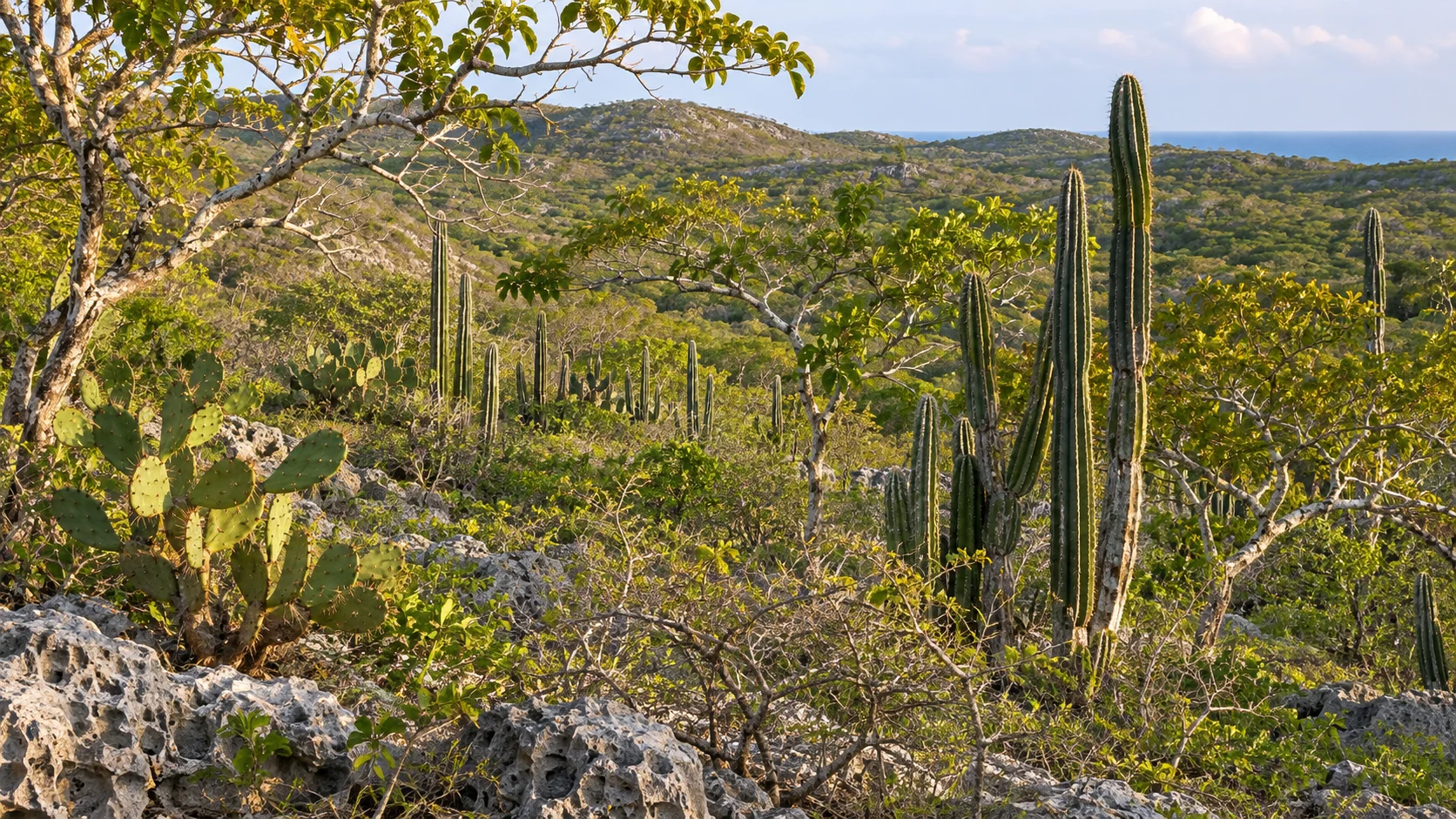
Tell the contact team your dates, base, preferred walking time and interest in plants, and ask what kind of interpretation can be arranged. The article's cover is a unique AI-generated illustration inspired by Jaragua's dry-forest landscapes. It is not a documentary photograph of a named site, a botanical identification plate, evidence that a species grows beside a particular path or a promise of flowers or conditions on your visit. Use it as an invitation to look more closely, then learn from the landscape you actually encounter.
Explore the living landscape of Jaragua
Browse the nature tours and share your interest in plants, preferred walking time and accommodation to discuss an outing with suitable interpretation.
Explore local tours