Marine wildlife and responsible visits
Sea Turtles in Cabo Rojo and Jaragua: What Visitors Should Know
Understand possible sea-turtle encounters, the difference from nesting and hatchlings, and how to visit Cabo Rojo and Jaragua without disturbing wildlife.
Turtles are part of the region, not a booking guarantee
Sea turtles belong to the wildlife story of Cabo Rojo and Jaragua in the Dominican southwest. Conservation work in the region has documented turtles in coastal feeding habitats and nesting on protected beaches. That makes them important to understand before visiting, but it does not make any particular boat departure a turtle-watching excursion. Plan an outing you would enjoy for its landscape and marine setting even if no turtle appears.
The Jaragua National Park guide introduces the wider protected area. This article answers the different questions raised by turtles: what an encounter means, how it differs from nesting, and how visitors can avoid causing disturbance. Regional records, an operator’s photograph and a recent report from another visitor do not establish a sighting on your travel date.
Marine encounters and nesting are different
A turtle swimming or feeding at sea is not the same experience as a female coming ashore to nest. Nor does either establish that hatchlings will emerge while you visit. These are different stages of the animals’ lives, taking place under different circumstances. A conservation patrol, a research project and an ordinary beach excursion have different purposes and permissions.
At Bahía de las Águilas, treat any wildlife encounter as incidental to your confirmed visit unless a responsible provider has explicitly explained a separately authorized activity. Do not infer night access, nesting observation or a hatchling release from the fact that turtles use the wider area. Conservation work described online is not an invitation to join it, and a guide cannot simply turn a beach booking into a research visit.
Understand the names without chasing a checklist
Local conservation accounts discuss hawksbill turtles (Eretmochelys imbricata), green turtles (Chelonia mydas) and leatherbacks (Dermochelys coriacea) in the region’s broader story. Hawksbill and green turtles are associated with coastal feeding habitats; nesting is a separate part of the conservation picture. These examples help explain why both marine habitats and beaches matter. They are not a list of species you should expect to see on one excursion.
If a guide identifies an animal, ask what features they observed rather than pursuing a closer view to settle the name. A brief or distant sighting can remain unidentified. Learning about the habitat and the conservation work is worthwhile without collecting a photograph of every species. Avoid turning regional conservation records or historical monitoring figures into a prediction of how many turtles a visitor will encounter.
Choose the actual excursion you want
The snorkeling comparison guide distinguishes beach time from a dedicated guided reef outing. Read it before assuming every Bahía de las Águilas visit involves the same underwater activity. A beach excursion can be worthwhile for the boat journey, scenery and permitted beach activities, while a snorkeling proposal needs its own equipment, supervision and suitability checks.
Compare the advertised guided snorkeling experience with the Bahía de las Águilas boat tour. Confirm the actual sites, inclusions, swimming ability expected and operating decision for your date. Neither page should be read as a guarantee of turtles. Clear-looking water, a particular season or an early departure does not establish safe snorkeling conditions or a likely wildlife encounter.
If you see a turtle in the water
Observe calmly, leave the animal room and follow the guide’s instructions. Do not chase, touch, hold, feed or surround it for a photograph. Keep its route to open water and the surface clear rather than swimming into its path. If maintaining the view would require leaving the supervised area or exceeding your swimming ability, let the animal go.
For photographs, use the view available from a respectful position rather than asking the guide to bring you closer. Avoid crowding with other swimmers or repeatedly following the animal after it moves away. Keep fins and equipment clear of the seabed and marine life. The goal is to observe a wild animal behaving naturally, not to create a posed encounter or a picture that depends on handling it.
If a turtle is on the beach
Give the animal space and alert the guide or responsible park personnel quietly. Do not approach for a selfie, gather a crowd, touch it or stand in its route between land and sea. Avoid directing lights or camera flash at it. Follow instructions about where visitors should remain and whether the group needs to move away.
Do not treat the encounter as permission to stay beyond the agreed visit or return after dark. A turtle ashore may need an undisturbed route, and visitors should not decide for themselves whether it is nesting or needs assistance. Keep children close and explain why watching from farther away is the appropriate response. Do not publish precise locations that could draw additional people to an active nesting area.
Nests, hatchlings and animals in difficulty
Respect marked areas and remain on permitted visitor routes. Do not dig into sand, uncover a nest, move eggs or handle hatchlings for a photograph or a supposed release. If you notice hatchlings, keep people from crowding them, avoid lights and seek instructions from the guide or responsible park staff. Do not improvise a relocation or carry animals to the water.
For an injured, stranded or entangled turtle, keep your distance and notify the guide or park personnel with a clear description of the location and what you observed. Do not enter unsafe water or attempt to cut lines, lift the animal or free it yourself. Trained responders need to assess the situation. A photograph taken without approaching may help them, but obtaining it should never add disturbance or put a visitor at risk.
Make the outing work for your group
Choose around the experience everyone can participate in, not a hoped-for animal sighting. The family travel guide helps with boarding, supervision, shade, meals and breaks. Non-swimmers should discuss what they can enjoy without entering the water; equipment alone does not establish that an activity suits their needs. Explain to children in advance that the animals may not appear and must not be touched.
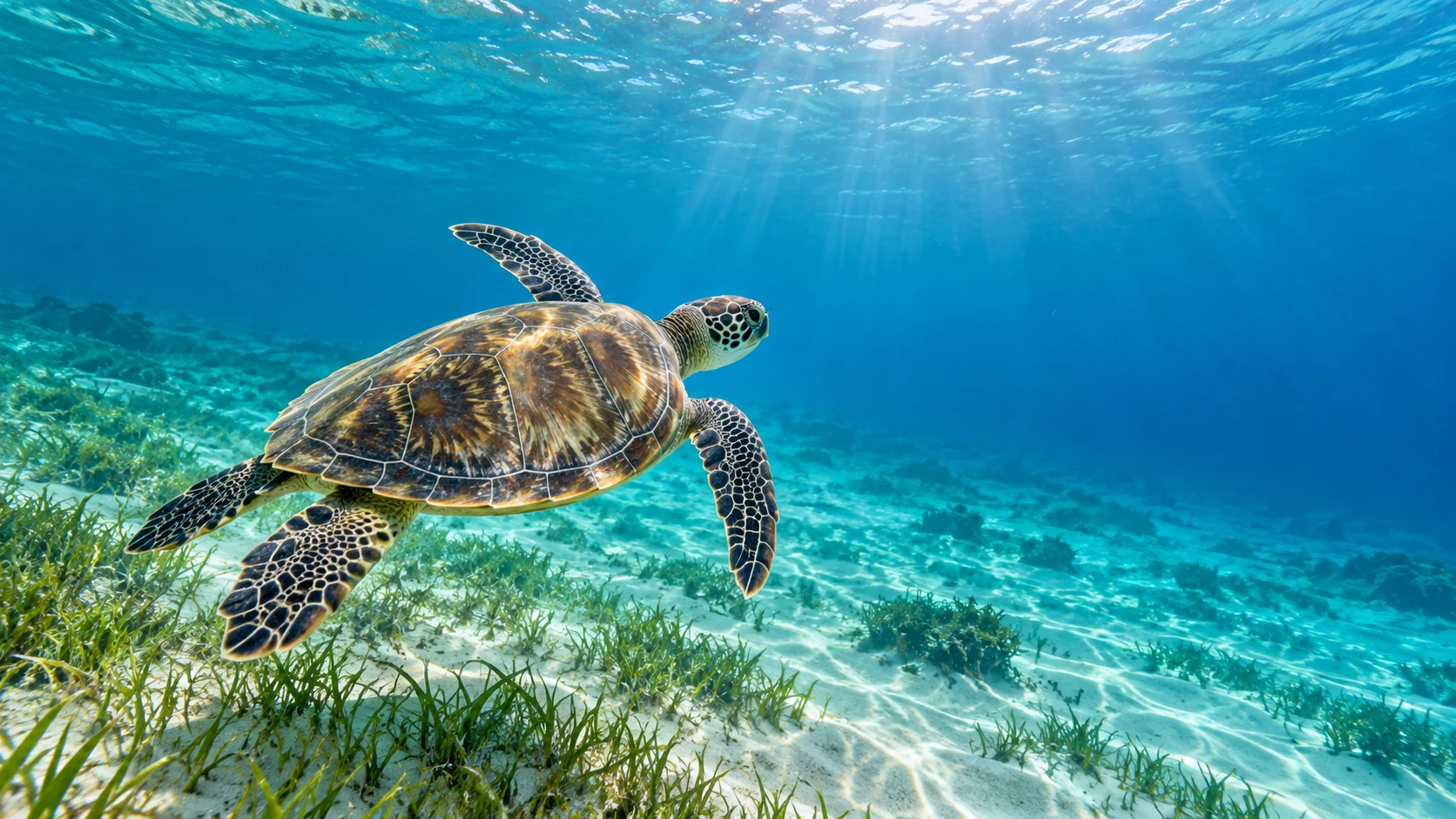
The packing guide supports practical preparation for the actual outing. Secure loose belongings and take your waste away. The cover is a unique AI-generated illustration inspired by a sea turtle in a Caribbean marine setting; it is not a documentary photograph of a local sighting, a nesting location or a guaranteed encounter on any excursion.
Keep your plans flexible and the habitat undisturbed
Use the seasonal planning guide for the broader holiday, then confirm current conditions for the specific outing. A regional nesting period is not an appointment with an animal, and marine encounters do not follow a visitor timetable. Ask what happens if the boat route changes, snorkeling is unsuitable or the outing must be postponed. Do not choose a date solely because someone has promised wildlife.
Keep beach vegetation, sand and marine habitats undisturbed, and follow the instructions for the area you are visiting. Leave natural objects in place and do not purchase turtle-shell souvenirs, eggs or turtle products. Ask how the provider avoids disturbing animals rather than seeking a closer encounter at any cost. Responsible visitor behaviour matters whether you see a turtle, find only information about one or spend the day enjoying another part of the coast.
Questions before booking
Will we definitely see turtles? No: wildlife presence in the region does not guarantee an encounter. Does a boat or snorkeling tour include nesting observation? Only an explicitly confirmed and appropriately authorized arrangement could establish that; do not assume such an activity is offered. Can we touch a turtle or release hatchlings? Do not seek or accept handling as a visitor activity. Is a specific month a guarantee? No; conditions and animal behaviour vary.
Send your dates, accommodation, group size, swimming experience and any access needs when asking about an excursion. Request the actual itinerary, supervision, equipment, inclusions and change terms. Use the contact page to clarify the advertised outing without assuming a specialist turtle product exists. Choose a well-described nature experience, and allow any wildlife encounter to remain a privilege rather than a condition of a successful day.
Choose a nature outing with clear expectations
Explore the advertised beach and snorkeling excursions, then share your dates, group and needs. Confirm the itinerary and inclusions without depending on a turtle sighting.
Explore local tours